Marketing and Analytics

Every company I talk to has the same problem.
They've invested millions in customer data. They have a CRM, a data warehouse, a loyalty system, an e-commerce platform, and analytics tools. The data is there. But when the marketing team wants to act on it — build a segment, trigger a campaign, personalize a journey — they hit a wall.
The culprit is usually a traditional CDP.
The Old Model: Buy a Box, Lock In Forever
Traditional Customer Data Platforms were built around a simple premise: buy one platform, plug everything in, get a unified customer view.
The reality? It rarely works that way.
Traditional CDPs take your data and store it in their system — a separate silo outside your existing data warehouse. Every event, every user attribute, every transaction gets duplicated and managed inside a vendor's black box. You pay for storage you didn't need. You wait 6 to 12 months for implementation. And when you want to add a new data source or switch an activation tool, you're back at the negotiating table.
The CDP Institute found that only 23% of companies completed their CDP projects on time and on budget. That's not a coincidence — it's architectural.
Enter the Composable CDP
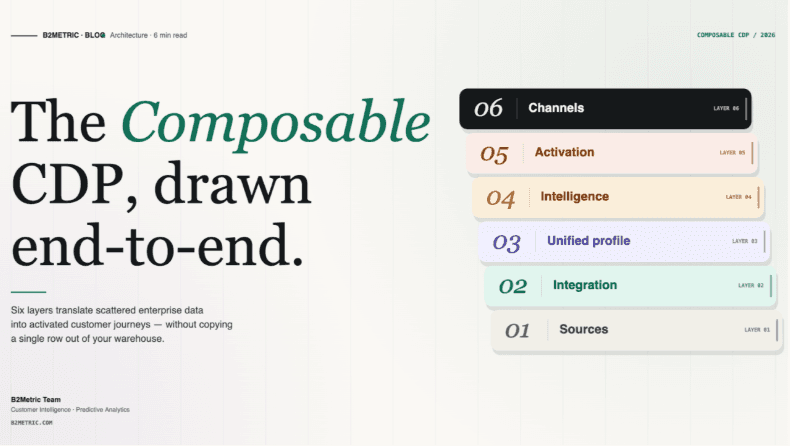
A Composable CDP flips the model entirely. Instead of pulling your data into a vendor's platform, it works on top of the infrastructure you already have — your cloud data warehouse (BigQuery, Snowflake, Redshift, Oracle, whatever it is). It activates the data where it lives, without creating a duplicate copy.
The key principles are simple.
Modularity — you choose the components you need (data ingestion, identity resolution, segmentation, activation) and only pay for what you actually use. No bundled software.
Flexibility — because the CDP sits in your warehouse, it can tap into all your data, not just web events or email clicks. CRM records, offline transactions, loyalty data, and ML model outputs can all feed into customer profiles and campaigns.
No vendor lock-in — if a component in your stack improves, you swap it out. Your data stays with you. Compliance with GDPR, KVKK, and other data regulations is far easier when you own the underlying infrastructure.
Speed — first use cases can go live in days or even hours, not months. You start small, prove value, and scale progressively.
How B2Metric Does It Differently
At B2Metric, we built our platform around the Composable CDP philosophy from day one — because we work with enterprises in Telecom, Finance, and Retail who already have complex, mature data infrastructures. A "bring your own warehouse" approach isn't a nice-to-have for them. It's a requirement.
Multi-source data integration, natively. B2Metric connects directly to BigQuery, Oracle, CRM systems, loyalty platforms, CSV sources, and more — without requiring data duplication. All integration sources are unified into a single data layer.
59 tracked events, 47 user properties — all queryable in real time. From App_session_start to Checkout_abandoned, from Last_order_value to Orders_offline, every behavioral signal and user attribute is available for segmentation and activation, sourced from wherever the data actually lives.
Identity resolution across sources. User properties are resolved using freshness and priority strategies across BigQuery, Oracle, CRM, and Loyalty sources simultaneously. No single source of truth is forced on you.
AI-powered activation, not just storage. Unlike tools that stop at data unification, B2Metric layers ML-based churn prediction, Next Best Offer, LTV scoring, and campaign orchestration directly on top of the unified customer profile — all composable, all modular.
The result: enterprise clients get a customer data foundation that is flexible enough to evolve with their business — without the 12-month implementation cycles or vendor lock-in of legacy CDPs.
The Bottom Line
The CDP market is undergoing a structural shift. Cloud data warehouses are becoming the center of the modern data stack — and the role of a CDP is no longer to own your data, but to activate it.
Composable CDPs are winning because they respect where data already lives, give teams modular control, and eliminate the tax of duplicating everything into a vendor's black box.
If your current CDP is slowing you down, locking you in, or failing to tap the full richness of your data infrastructure, it might be time to rethink the architecture.