
You Don't Have a Conversion Problem. You Have a Visibility Problem.
Most analytics tools tell you what happened. Very few tell you where things broke — and almost none show you what happened next.
We built Flow Analytics inside B2Metric to solve exactly that.
The Visibility Problem
Most teams know something is breaking in their checkout flow. They can see it in the conversion rate. But when I ask them where exactly users are dropping, they go quiet.
Not because they're not smart. Because their tools weren't built to answer that question.
Traditional funnels require you to define the path before you can analyze it. You have to know already what you're looking for. And if the leak is somewhere you never thought to look, you never find it.
That's the visibility problem.
How Flow Analytics Works
You pick any event as a starting point — a payment step, a coupon attempt, a cancellation signal, a new feature touch. The platform then maps every path your users actually took before and after that moment. No pre-setup. No hypothesis required. No funnel to configure.
Just pick an event, set your time window, and read the map.
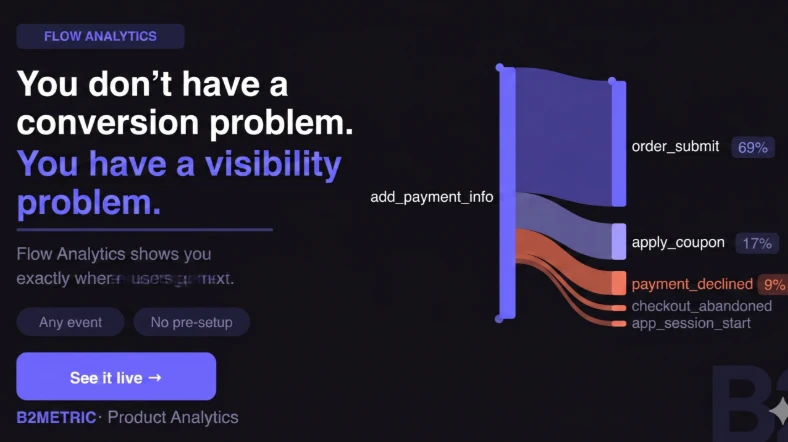
The Sankey diagram shows you the real branching behavior: which paths dominate, where volume leaks, and which sequences are surprisingly common. You can change the number of steps, filter by segment, and switch time windows (7D, 30D, 3M, 12M) to instantly see how behavior shifts.
It's exploratory. You don't need a hypothesis to start. You just pick an event and let the data tell you what's happening around it.
5 Use Cases Where This Changes Everything
Checkout and Payment Recovery (E-commerce / Retail) — start from add_payment_info. You'll immediately see what percentage flows to order_submit versus payment_declined versus checkout_abandoned. But the real insight is one step further: of users who hit payment_declined, how many retry, how many apply a coupon, and how many disappear entirely? That split alone tells you whether you have a payment UX problem, a pricing confidence problem, or a trust problem. Three different problems. Three different fixes.
Onboarding Drop-off (SaaS / Fintech / Banking) — start from account_created and trace the next 4 steps. You'll find the moment where 30% of new users vanish — and it's rarely where the team assumed. We've seen it be a document upload step that silently fails on mobile, or an ID verification flow that routes users to a third-party screen with no back button.
Subscription Churn Signals (Telecom / Insurance / Streaming) — start from plan_downgrade_initiated or cancellation_page_viewed and trace backwards. At one of our Telecom clients, users who visited support chat twice before hitting the cancellation page were churning at 3x the rate of those who went directly. That behavioral sequence became a trigger for an automated retention journey inside Flowly.
Feature Adoption Gaps (Product Teams) — start from a new feature event and trace what happens next. Are users going deeper or bouncing back to the homepage? Is there a segment that engages repeatedly while the majority touches it once and never returns? Flow Analytics shows you both the happy path and the dropout sequence side by side.
Fraud and Anomalous Behavior Detection (Finance / Banking) — start from large_transfer_initiated. Legitimate users typically go through 4–6 natural navigation steps. Suspicious sessions tend to jump directly to high-value actions with minimal prior activity. Flow Analytics makes those divergent paths visually obvious in seconds.
What Makes This Different
Most product analytics tools require you to define a funnel before you can analyze it. Flow Analytics flips that. You start from any moment in the user journey and the platform shows you the natural paths your users are actually taking.
Instead of reporting "our checkout conversion is 68%," your team can say "68% of users who add payment info submit the order — but 14% hit a declined state, and of those, 40% abandon entirely without retrying." That's actionable. That's the difference between a metric and an insight.
We're seeing product and CX teams at companies like Türk Telekom, STC Telecom, and Ebebek.com use Flow Analytics to surface drop-off patterns they had no idea existed — and then feed those findings directly into Flowly to run recovery campaigns automatically.
Analytics that connects to action. That's the whole idea.