Technical Insights

Picture an analyst at a fintech firm. Every morning she spends two hours pulling numbers from the database, cross-referencing last quarter's report, trying to remember how the team defined "active customer" three months ago. Then she formats a table in Excel, writes a summary that's unlikely to be read in full, and sends it to her manager. The manager asks a follow-up question; the cycle starts again.
This is not a data problem. The data is there. It's a translation problem.
What We Built at a Fintech
The client was a large-scale financial services firm. Oracle database, BI dashboards, internal knowledge docs — everything existed, but tying it together consumed several hours of analyst time every day. Reporting cycles were heavy. Time spent pulling data left no room for interpreting it.
We integrated B2Metric Asky as an agentic conversational layer on top of their existing infrastructure.
Here's how it works in practice. The analyst types a plain-language question: "How does the SME segment's 90-day churn trend compare to last year?" No SQL. No 40 open tabs. Just the question.
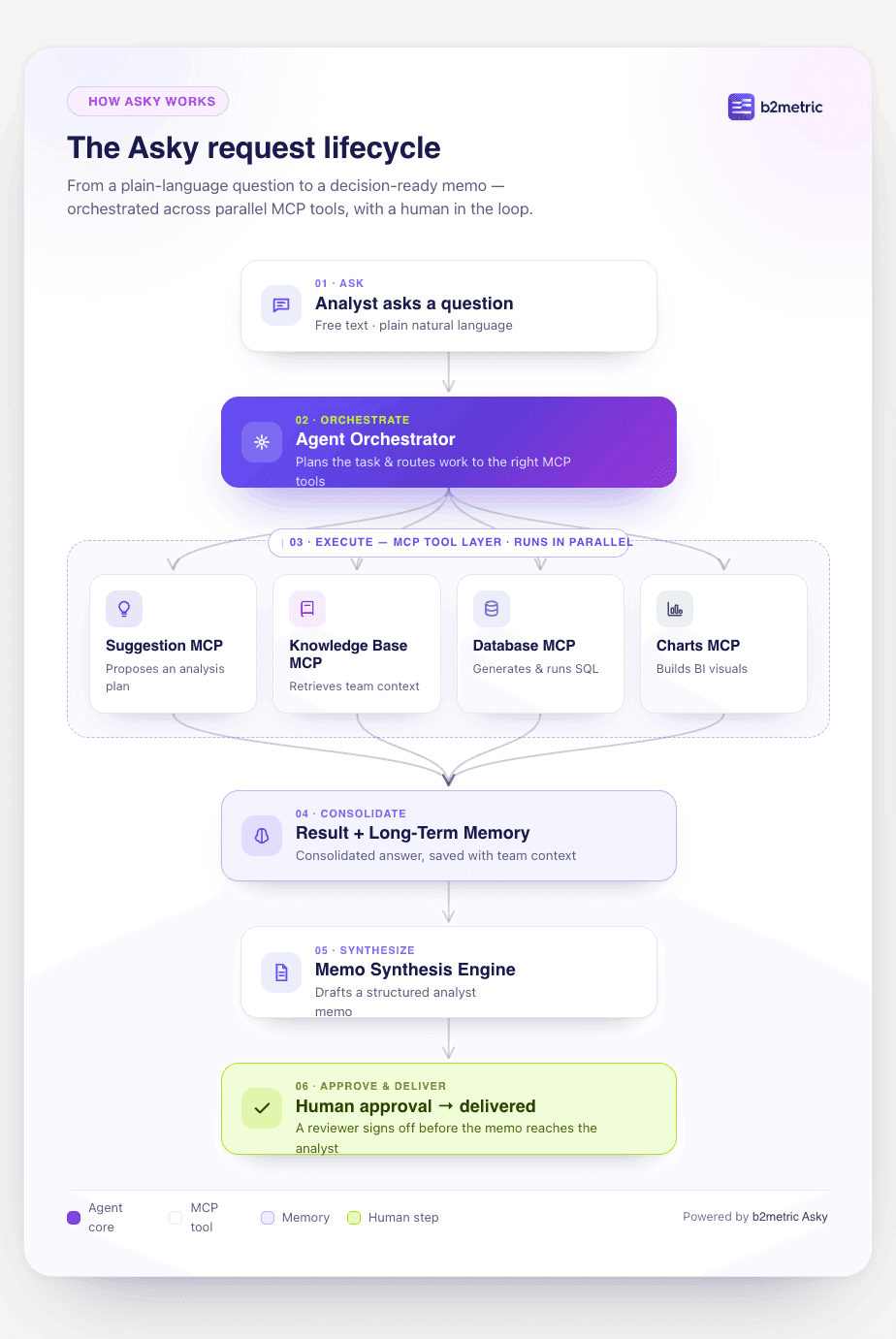
Behind it, a lot happens fast: the Agent Orchestrator interprets the intent and plans which tools to call, Suggestion MCP proposes an analysis approach and flags follow-up questions, Knowledge Base MCP retrieves institutional context, Database MCP generates and safely executes SQL against the live database, Charts MCP builds the visualizations and pushes them to the BI dashboard, all outputs merge with Long-Term Memory, and the Memo Synthesis Engine drafts a structured analyst memo from everything above. The analyst reviews, approves, or rejects — the final version is published.
The entire process runs inside the firm's own environment. The data never leaves.
B2Metric Asky - Talk to Your Data Agent Orchestration
Why This Architecture Matters in Banking and Telecom
Most AI analytics demos show you a clean interface over clean data. Real enterprise deployments don't look like that.
In banking, you have Oracle databases with decades of schema decisions baked in. In telecom, you have subscriber data sitting under KVKK, PDPL, SAMA, and a dozen other regulatory frameworks depending on which market you're in. You can't route customer data through a third-party API and call it conversational analytics.
The MCP (Model Context Protocol) server architecture solves this directly. Each MCP server — Knowledge Base, Database, Charts, Suggestion — is a controlled, sandboxed interface. The Database MCP doesn't expose raw database access; it generates SQL, validates it, and executes it safely. The Knowledge Base MCP retrieves from curated embeddings, not the open internet. Everything is logged, auditable, and stays within the data perimeter.
For banks operating under central bank oversight, or telecoms handling subscriber data across GCC markets, this isn't optional. It's the only way an AI analytics layer actually gets deployed.
The Human Approval Gate Is Not a Feature. It's the Product.
One thing I keep seeing AI analytics platforms get wrong: they treat human review as friction to be eliminated.
We designed it the other way. The validation gate — where an analyst approves or rejects the drafted memo before it's published — is what makes the system trustworthy enough to use in a regulated environment.
An AI that produces an unreviewed memo and sends it to a manager creates liability. An AI that drafts a memo, shows its reasoning, and asks a human to sign off creates efficiency. The difference matters enormously when the output informs a credit decision, a regulatory report, or a board presentation.
Asky's architecture keeps the analyst in control at the moment it counts. Automation handles the 90% of work that is mechanical and repetitive. The analyst handles the 10% that requires judgment, context, and accountability.
What This Looks Like in Telecom
The same pattern applies in telecom — different data, different regulatory context.
A data analyst at an operator wants to know which postpaid segments are showing early churn signals in Q3. Right now that means querying subscriber tables, joining to usage data, filtering by segment, comparing against historical baselines, and writing up the findings. Two to four hours on a good day.
With Asky integrated over the operator's data warehouse — Oracle, BigQuery, Redshift, or anything else — the analyst types the question in plain language. The agent handles query construction, retrieves relevant context from prior analysis, generates the visualization, drafts the memo. The analyst reviews, approves, moves on.
The data never leaves the operator's environment. The SQL is logged. The memo is versioned. The whole workflow is auditable. For operators under PDPL in Saudi Arabia, KVKK in Turkey, or PDPA across Southeast Asia, that auditability is what makes deployment feasible.
Long-Term Memory Is Where the Value Compounds
Every time an analyst defines a term, rejects a memo formulation, or adds context to a response, that goes into Long-Term Memory. The next time a question comes in that touches the same topic, the agent already knows how the team thinks about it.
Month one, Asky saves two hours a day. Month six, Asky is producing first drafts that need minimal revision because it has internalized the team's preferences, definitions, and reporting standards. The system gets better as the team uses it. That's a different kind of ROI calculation than most analytics tools offer.
What We're Seeing Across Markets
We've run similar deployments across banking in South Asia, telecom in GCC, and insurance in Turkey. The specific data stacks vary — Oracle in banking, CDRs in telecom, policy management systems in insurance. The underlying pattern is the same: valuable data locked behind query interfaces that analysts don't have time to use efficiently.
The conversation-to-insight gap is real across every one of these sectors. Regulatory complexity is high. Tolerance for data leaving the environment is near zero.
That's exactly the problem Asky was built to solve.
If you're running analytics teams in banking, telecom, or insurance and the reporting cycle still involves a lot of manual SQL and Excel, reach out at b2metric.com — we'd be glad to walk through what this looks like for your stack.