

Tutorials

B2Metric CDP: Turn Churn Prediction into Actionable Customer Growth with AI-Native CDP

Emincan Tetik

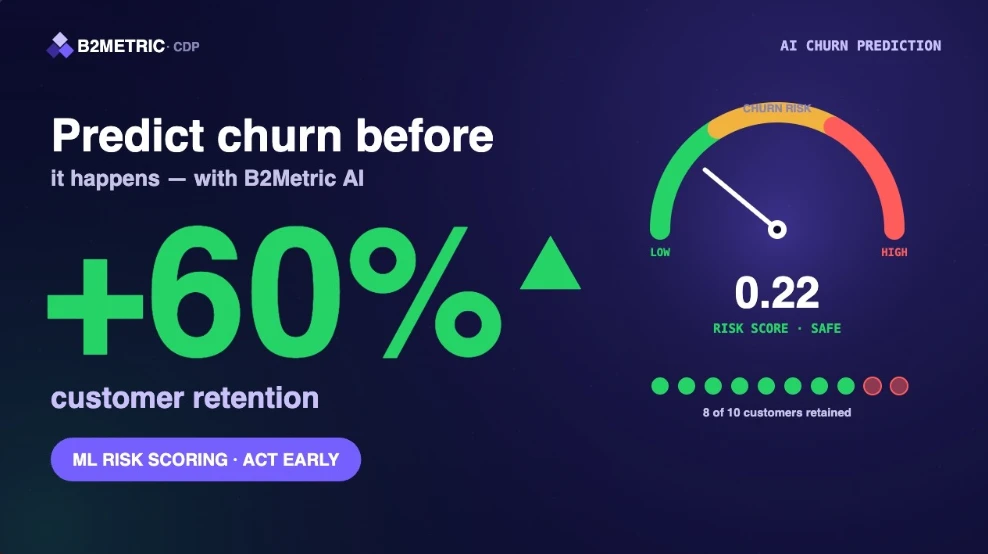
Most companies can predict churn. Very few know what to do with it.

Knowing that a customer has a 78% probability of leaving is only useful if it triggers the right action — the right message, through the right channel, at the right moment. Without that last mile, the prediction just sits in a dashboard.

In this session, we break down how customer churn prediction models work, how to interpret churn scores, and how to turn those insights into actionable customer segments and campaigns that actually move retention metrics.


What You'll Learn

What a customer churn prediction model is and how it works — the mechanics behind machine learning models that identify at-risk customers before they leave.

How churn scores are calculated and interpreted — understanding the difference between a 0.4 score and a 0.8 score, and what each means for your CRM strategy.

How to identify high-risk customers — which behavioral signals matter most, and how B2Metric surfaces them automatically.

How to segment users based on churn probability — not all at-risk customers are the same. High-risk vs. medium-risk, price-sensitive vs. engagement-dropped, each group needs a different approach.

How to design and activate campaigns using churn insights — from segment definition to campaign trigger, closing the loop between prediction and action inside a single platform.

Who This Is For

This session is built for marketing and growth teams, CRM professionals, data analysts, and anyone working on customer retention and lifecycle marketing. No data science background required — the goal is practical application, not model theory.

This session is part of the B2Metric Insurance Event and includes real-world approaches used in the insurance industry — one of the highest-stakes environments for churn prediction and retention.

Instead of reacting to churn after it happens, learn how to predict it early, segment your users, and take action with campaign orchestration.
Most companies can predict churn. Very few know what to do with it.

Knowing that a customer has a 78% probability of leaving is only useful if it triggers the right action — the right message, through the right channel, at the right moment. Without that last mile, the prediction just sits in a dashboard.

In this session, we break down how customer churn prediction models work, how to interpret churn scores, and how to turn those insights into actionable customer segments and campaigns that actually move retention metrics.


What You'll Learn

What a customer churn prediction model is and how it works — the mechanics behind machine learning models that identify at-risk customers before they leave.

How churn scores are calculated and interpreted — understanding the difference between a 0.4 score and a 0.8 score, and what each means for your CRM strategy.

How to identify high-risk customers — which behavioral signals matter most, and how B2Metric surfaces them automatically.

How to segment users based on churn probability — not all at-risk customers are the same. High-risk vs. medium-risk, price-sensitive vs. engagement-dropped, each group needs a different approach.

How to design and activate campaigns using churn insights — from segment definition to campaign trigger, closing the loop between prediction and action inside a single platform.

Who This Is For

This session is built for marketing and growth teams, CRM professionals, data analysts, and anyone working on customer retention and lifecycle marketing. No data science background required — the goal is practical application, not model theory.

This session is part of the B2Metric Insurance Event and includes real-world approaches used in the insurance industry — one of the highest-stakes environments for churn prediction and retention.

Instead of reacting to churn after it happens, learn how to predict it early, segment your users, and take action with campaign orchestration.
Related Blogs