
Composable CDP: A Practical Guide for Telecom, Banking and Retail (2026)
A composable CDP is a customer data platform that works on top of the data warehouse you already have, instead of keeping its own copy of your customers. The idea has reshaped the CDP market since 2022, and it matters most for companies with rich, regulated customer data.
Most companies we talk to do not have a data shortage. They have years of transactions, subscriptions, usage records, app events and model scores spread across a warehouse, a CRM and a handful of operational systems. The hard part is using that data while it still matters. Announcing our partnership with Telesign, our CEO Murat Hacıoğlu said the challenge is "turning it into action at the moment it can influence an outcome."
That gap between having customer data and acting on it is what customer data platforms were built to close. This guide explains where the idea came from, what it gets right, where its critics have a point, and how the conversation has shifted now that AI agents are entering marketing. It closes with a checklist you can use when choosing an architecture for your own team.
A short history of the CDP
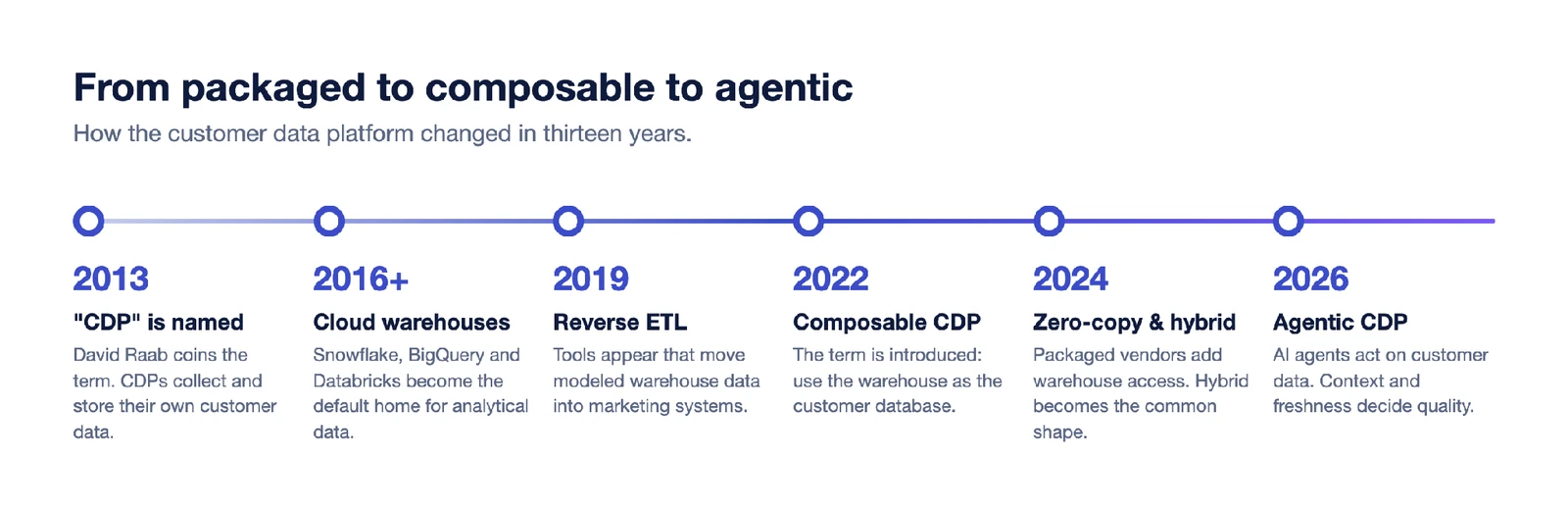
The term "customer data platform" was coined in 2013 by David Raab, who later founded the CDP Institute. The Institute's definition is still the standard one: packaged software that creates a persistent, unified customer database that other systems can access. The first generation of CDPs grew out of marketing technology. They collected web and app events with their own tags and SDKs, stored them in their own database, stitched identities into profiles, and pushed audiences to ad networks and email tools.
That design made sense at the time. In 2016, Snowflake had only around a hundred customers, and most companies did not have a central cloud warehouse that a marketing tool could read from. If marketing wanted a single customer view, buying a CDP that built and stored one was the fastest route.
Then the data stack changed. Cloud warehouses such as Snowflake, BigQuery, Redshift and Databricks became the default place for analytical data. Tools like Fivetran and dbt made it routine to load data from every source system and model it in SQL. Data science teams started training churn, lifetime value and propensity models directly on warehouse tables. By 2019 a new category called reverse ETL appeared, with Hightouch and Census among the first vendors, to move modeled data out of the warehouse and into the operational tools where marketers worked.
In April 2022, Hightouch published a post called "The CDP as we know it is dead" and introduced the term composable CDP. The argument was simple. If the customer data is already in the warehouse, cleaned and modeled, why copy it into a second database owned by a marketing vendor?
From packaged to composable to agentic
What is a composable CDP?
A composable CDP is a customer data platform built from separate layers on top of a company's own data warehouse or lakehouse. It reads customer data where it already lives, so profiles, segments and model scores come from one source of truth instead of a second copy held by a marketing vendor.
Composable CDP vs. packaged CDP
A packaged CDP bundles every job into one product. A composable CDP splits those jobs into layers, and each layer can be filled by a different tool or by your own code.
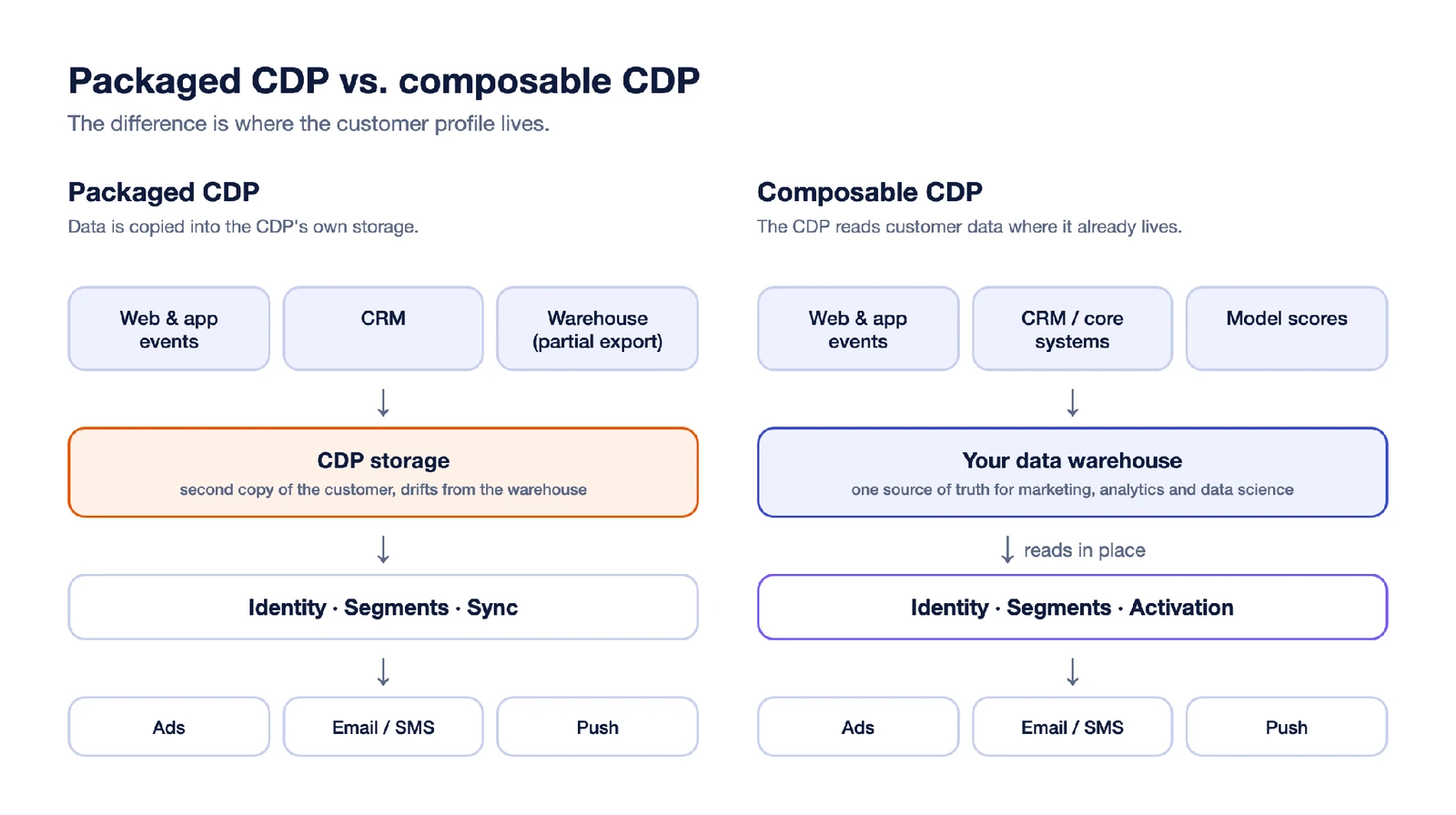
Packaged CDP vs. composable CDP
The layers usually look like this:
Layer
What it does
Typical options
Collection
Captures web, app and server events and loads data from source systems
SDKs, server-side tracking, ELT tools, change data capture, streaming ingest
Storage
Holds the system of record for customer data
Snowflake, BigQuery, Databricks, Redshift, ClickHouse, Oracle or another on-prem warehouse
Modeling and identity
Cleans data, stitches identifiers into one customer, computes traits and scores
SQL and dbt models, identity resolution in the warehouse, ML models
Audience building
Lets marketers define segments without writing SQL
Visual segment builders that query warehouse tables
Activation
Sends audiences and events to channels and tools
Reverse ETL, journey orchestration, direct channel integrations
Governance
Controls consent, access, PII and retention
Warehouse access controls, consent filters, audit logs, clean rooms
The important part is the storage row. In a composable setup, the customer profile lives in a database the company already owns and governs. Marketing, analytics and data science read the same tables. When finance asks why the number of active customers in a campaign report differs from their own, there is only one table to check.
Benefits of a composable CDP
The data marketers need is no longer just clickstream
A packaged CDP is very good with the data it collects itself: page views, app sessions, clicks, form submissions. For many businesses that is the least interesting data they have.
A bank's most useful signals are product holdings, transaction patterns, credit limits and risk scores. A telecom operator cares about tariff, data usage, roaming, contract end date, device age and network quality. A retailer wants loyalty tier, store visits, return rates and stock levels. None of this arrives as a website event. It lives in core systems and reaches the warehouse through batch loads and change data capture.
When the CDP reads from the warehouse, all of these attributes are available for segmentation from the start. When the CDP keeps its own store, each new attribute becomes an integration project.
Model scores already live in the warehouse
Most data science teams train and score models where the data is. A churn score calculated every night on warehouse tables is immediately usable in a composable setup. In a packaged CDP, someone writes an export job to push the score into the CDP's schema, and that job tends to break when either side changes.
Flexible data models
Packaged CDPs usually assume a fixed shape: a user, maybe an account, and a stream of events. Real businesses have households, subscribers with several SIM cards, corporate customers with many retail users under them, insurance policies with multiple insured people, and products with their own lifecycles. A composable CDP follows the data model you already have instead of forcing your data into a vendor's model.
Data residency and control
For regulated industries this is often the deciding factor, and we return to it in its own section below. If customer data never has to leave the company's environment to build a segment, a large share of the compliance work disappears.
Time to first campaign
Hightouch and other composable vendors argue that traditional CDP projects take three to six months before the first campaign goes out, mostly because of data ingestion and schema mapping. These are vendor claims, but they match what we see in practice: when the warehouse is already in good shape, the first live audience can come from existing tables within weeks.
Limitations of a composable CDP
Composable CDP has been one of the loudest ideas in marketing technology, but it has not replaced packaged CDPs, and the reasons deserve attention.
Packaged CDPs still dominate the market
In August 2024, the CDP Institute looked at employment across CDP vendors. Composable vendors such as Hightouch, Census, RudderStack and GrowthLoop had about 719 employees combined. Packaged CDP vendors had 16,848. A 2025 update put composable vendors at under 5% of the market, although they were growing faster. Raab's conclusion was that composable was not "eating the CDP industry's lunch". The slowdown in packaged CDPs had more to do with lower technology budgets, IT taking control of customer data decisions, and companies building in-house.
Someone still has to do the hard data work
Raab has also warned that IT teams "often underestimate the requirements for a proper CDP". Identity resolution, deduplication, consent handling and profile aggregation are real engineering work. A composable CDP does not remove that work. It moves it from the vendor to your data team. Amperity makes the same argument more bluntly, describing hundreds of hours of normalization and identity work that a warehouse-only approach pushes onto data engineers.
Real-time is harder in a warehouse
Warehouses were built for analytics. A reaction within a second of a customer event, such as an abandoned basket, a failed payment or a sudden drop in data usage, has traditionally been hard to achieve with batch syncs that run every hour. This gap has narrowed. Snowflake's streaming ingest makes data queryable within seconds, and BigQuery continuous queries can push results to a message queue as data arrives. Still, in-session personalization on a website or app usually needs an event stream that does not wait for the warehouse.
Warehouse cost and lock-in move, they do not vanish
Running identity resolution and refreshing hundreds of audiences on warehouse compute costs money. Packaged vendors claim this can multiply a warehouse bill, and while those numbers come from competitors and should be read that way, the cost is real and belongs in any total cost comparison. Lock-in also changes direction. A composable setup reduces dependence on a CDP vendor and increases dependence on the warehouse.
Hybrid CDP: where most enterprises end up in 2026
The debate has become less binary over the last two years, because both sides adopted each other's ideas.
Packaged vendors added warehouse access. Salesforce launched its Zero Copy Partner Network in April 2024, letting Data Cloud use tables in Snowflake, BigQuery, Databricks and Redshift without copying them. Twilio Segment added Linked Audiences, which build segments directly on warehouse data. mParticle, now part of Rokt, markets itself as a hybrid CDP.
Composable vendors moved in the other direction and added event collection, identity resolution and real-time features of their own.
Analysts now describe the market in these hybrid terms. In its 2026 Magic Quadrant coverage, Gartner described two directions for CDPs: "platformization", where the CDP becomes part of a larger suite, and "agentification", where the CDP becomes the entry point for AI agents that act on customer data. In September 2026, Forrester's Joe Stanhope wrote that B2C CDPs are entering a "utility era" where they are judged by the decisions they enable, and that "there is no universal best CDP."
The practical pattern we see most often in large companies looks like this: the warehouse remains the system of record for profiles, history and model scores, a real-time layer handles collection and fast triggers, and the CDP reads both without keeping a separate copy of everything.
Agentic CDP: how AI agents change the question
The arrival of AI agents in marketing is the biggest shift since the composable debate started. Hightouch now describes an "agentic CDP" in which long-running agents look for opportunities across customer data. In June 2026, Databricks announced CustomerLake, an agentic CDP built directly on its lakehouse, with campaign agents and agentic identity resolution in private preview. Forrester called it a litmus test for agentic marketing.
Whatever the vendor, an AI agent that decides who should get which offer is only as good as the context it can see. An agent that only sees clickstream will recommend the wrong things to a bank customer whose real story is in their transactions and product holdings. An agent that sees the full customer record, including the scores data science already produces, can make decisions that hold up when a human reviews them.
This is why we describe B2Metric as an AI-native CDP with "AI built-in, not bolted on". The composable question used to be about where to store data. With agents, it becomes a question of what context the agent has, how fresh that context is, and who controls it.
Data residency: CDPs under KVKK and Saudi PDPL
Many of our customers operate in Turkey and the Middle East, where data protection rules have tightened in the last two years.
In Turkey, Law No. 7499 rewrote Article 9 of the KVKK, the personal data protection law, on cross-border transfers. Since June 2024, transfers abroad rely on adequacy decisions or appropriate safeguards such as standard contracts and binding corporate rules, with explicit consent only as an exception. Companies that had been transferring data systematically on the basis of consent had until September 2024 to move to the new mechanisms. Banks face additional rules from the banking regulator BDDK on where customer data may be processed.
In Saudi Arabia, the transition period of the Personal Data Protection Law ended in September 2024, and the updated data transfer regulation sets similar conditions for moving personal data out of the country. The UAE has its own federal PDPL.
For a CDP, this has a concrete consequence. Every time a platform copies customer data to a SaaS service hosted in another country, that copy is a cross-border transfer that needs a legal basis and paperwork. A CDP that reads data where it already lives, inside the company's own environment or in a local data center, removes most of those transfers. Activation still sends some data to channels such as ad platforms, so the count of PII destinations is worth tracking. But the profile itself, with its most sensitive attributes, can stay at home.
Composable CDP use cases by industry
Composable CDP for telecom
Telecom operators have some of the richest customer data of any industry and some of the strictest constraints on moving it. Usage and network records are far too large to copy into a SaaS CDP, and in the Gulf and Turkey they often cannot leave the country at all.
The composable approach fits well here. Churn and next best offer models run on usage, billing and network data where it already sits. Real-time triggers such as a roaming event, a data cap warning or a failed top-up come from an event stream. Campaigns use both.
Türk Telekom used B2Metric's uplift modeling across about 60 million customers to decide which customers a campaign would actually change, and which would have bought anyway. The result was a fourfold increase in campaign return and a 60% improvement in campaign efficiency. For a large telecom operator in the GCC, B2Metric unified data from the Oracle data warehouse, CRM, network and social sources into a single customer view and built churn, segmentation and next best action models on top, deployed on-premise.
Composable CDP for banking, fintech and insurance
Financial institutions keep their most valuable customer attributes in systems that compliance will not let them copy freely: credit scores, risk ratings, product eligibility, transaction patterns. A composable CDP lets marketing build audiences on those attributes while consent rules and access controls stay enforced at the data layer. A marketer can target customers who are eligible for a product without ever seeing the underlying risk data.
MetLife used B2Metric's churn prediction to reduce churn by 26%, saving about $2.1 million and improving call center retention by 12%.
Composable CDP for retail and e-commerce
Retailers have the opposite problem from telecom. Their data is spread across e-commerce, stores, loyalty programs and marketplaces, and the hard part is joining it. Stock levels, store locations and return rates live in ERP and POS systems, so use cases such as suppressing ads for out-of-stock products or sending offers tied to a shopper's nearest store depend on reading operational data. A composable CDP that reads those tables directly can use them in segments without a new integration for each one.
Media and subscriptions
Media and subscription businesses care most about engagement and churn. Their data combines content consumption events with subscription and billing records. The billing side usually lives in the warehouse, the engagement side arrives as events, and the most useful audiences need both.
How B2Metric approaches the composable CDP
B2Metric describes itself as an agentic marketing platform with a composable CDP. In practice that means three things.
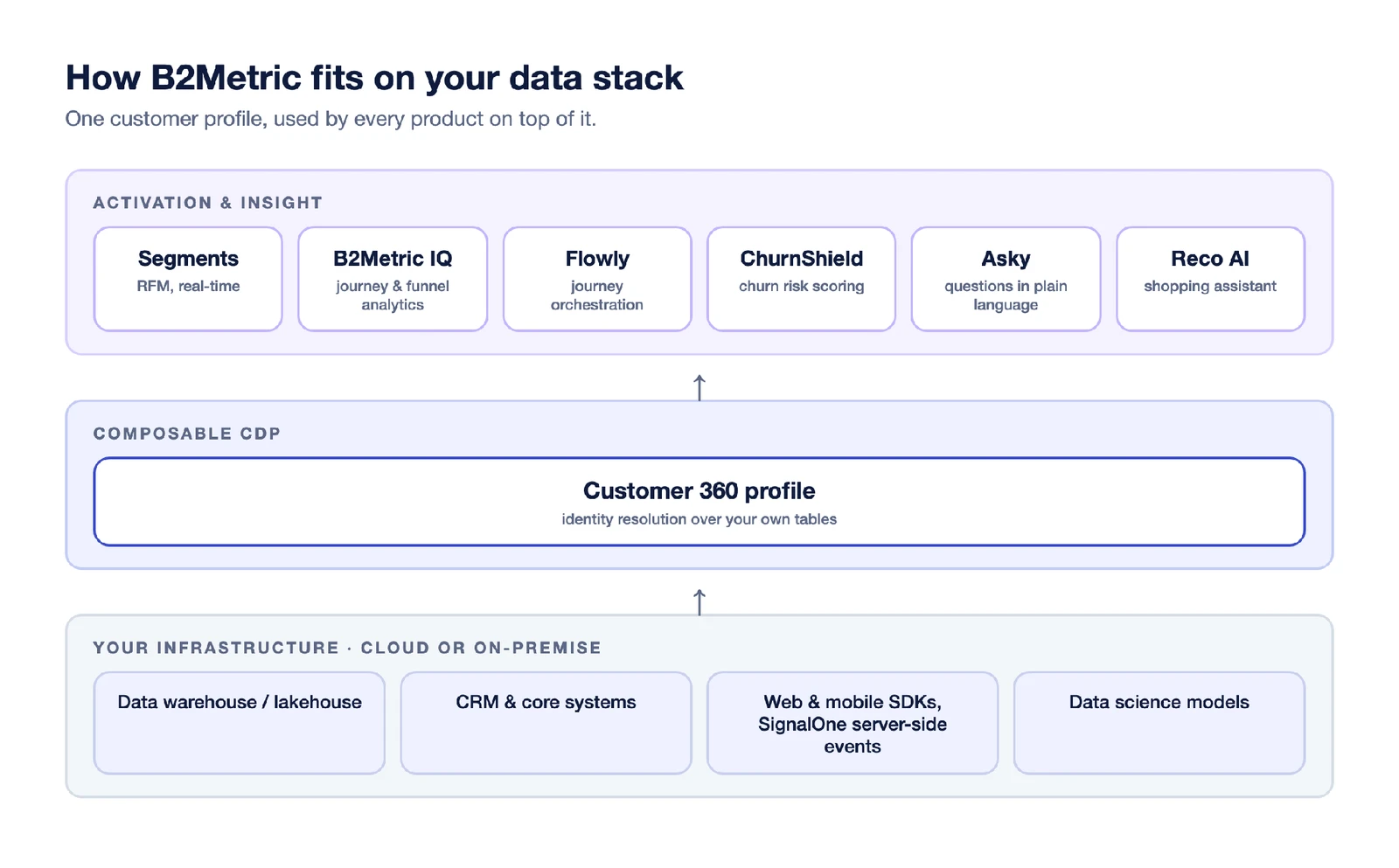
How B2Metric fits on your data stack
First, the CDP connects to the data infrastructure our customers already run. Supported sources include Snowflake, BigQuery, Redshift, ClickHouse, Oracle, Microsoft SQL Server, MySQL, DynamoDB and Amazon S3, plus product analytics tools such as Amplitude, Mixpanel and Firebase and attribution tools such as Adjust and AppsFlyer. With Snowflake, B2Metric works as a composable layer on top of the customer's account, and the data stays in Snowflake. A B2Metric application can combine several data sources at once, for example web and mobile SDK events, a CRM and a loyalty system, and each profile attribute can be sourced from the system that owns it.
Second, the platform can run where the data has to stay. For our telecom and banking customers that often means on-premise deployment. SignalOne, our server-side tracking product, sends first-party data to Google Analytics, Google Ads, Meta and TikTok with consent checks and PII hashing, is KVKK and GDPR ready, and offers a Turkish data center option.
Third, AI is built into the CDP from the start. On top of the Customer 360 profile:
- B2Metric IQ provides customer journey analytics, segmentation, RFM, funnel and retention analysis.
- Flowly orchestrates journeys in real time across push, email, in-app messages and WhatsApp, using propensity scores and next best action.
- ChurnShield is an AI agent that predicts churn, explains the prediction and triggers retention actions.
- Asky lets business users ask questions about their data in plain language, and it can run on-premise with a local language model.
- Reco AI is a shopping assistant that recommends products in conversation on e-commerce sites.
Because all of these read the same customer profile, a score or attribute added once is available to segments, journeys, agents and reports without an export job for each.
How to choose between composable, packaged and hybrid CDPs
There is no single right answer, and anyone who tells you otherwise is selling one model. These questions usually make the decision clear.
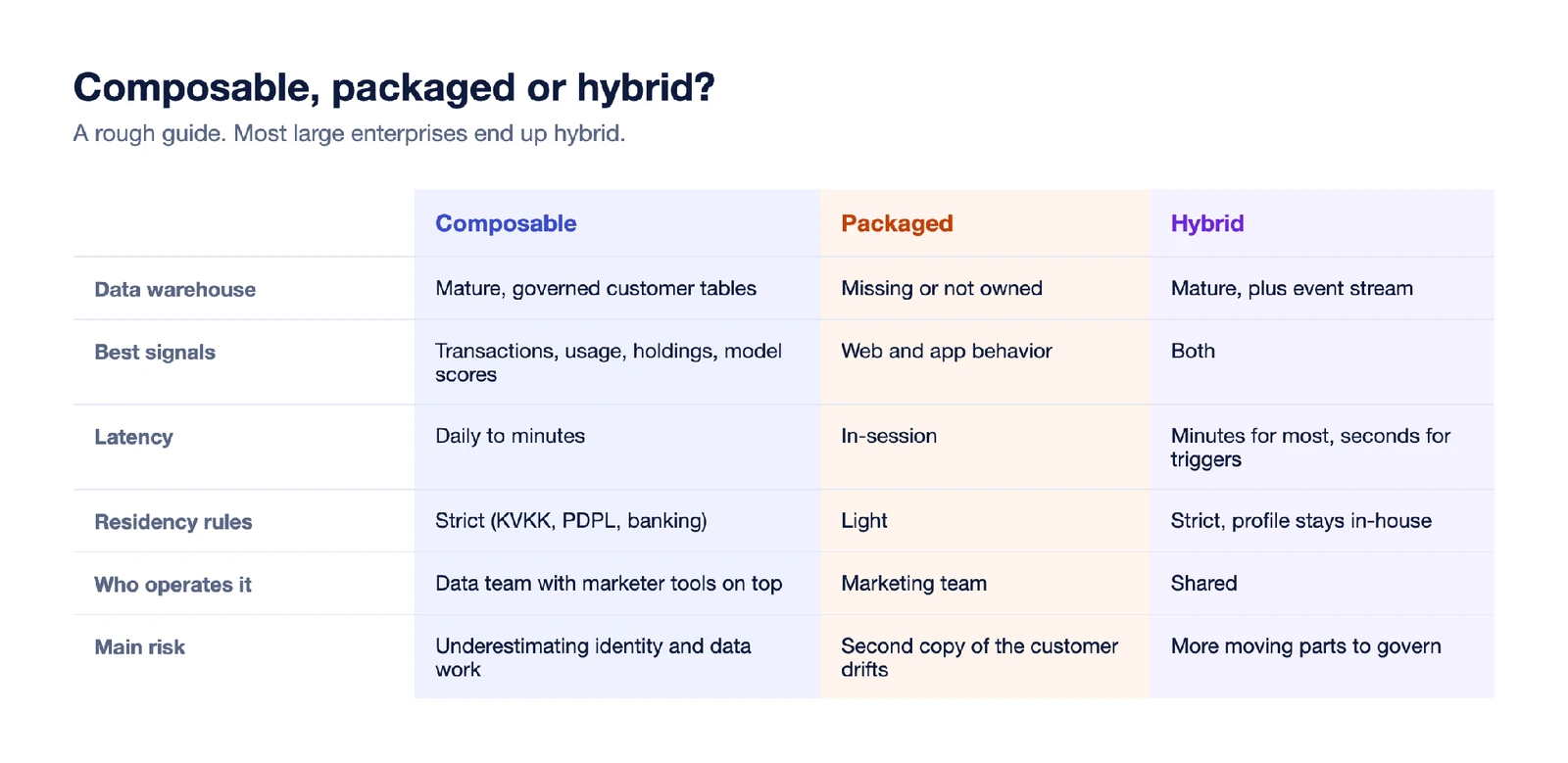
Composable, packaged or hybrid
- How mature is your warehouse? If you already have governed customer tables and a data team that works in SQL, composable is a realistic option. If customer data is still scattered and nobody owns it, a packaged CDP may get you to the first campaign faster, although you will face the same data problems later.
- What latency do your use cases need? Write down your top use cases and the reaction time each needs: daily, within minutes, or within the session. Daily and minute-level use cases work well on a warehouse. In-session personalization needs a real-time layer.
- How complex is identity? Customers who log in, or who are identified by a subscriber or account number, are easy to resolve in the warehouse. Heavy anonymous and cross-device matching needs more specialized tooling.
- What data drives your best use cases? If the strongest signals are transactions, usage, holdings and model scores, a CDP that reads the warehouse has a clear advantage over one that starts from clickstream.
- Where must the data live? Check KVKK, PDPL, GDPR and sector rules, list every system that would hold PII, and ask whether the vendor can run on-premise or in your region.
- What will it cost in total? Include warehouse compute for identity and audience refreshes, sync pricing, licenses, and the people who will operate it. Ask vendors for customer references instead of their own cost comparisons.
- Who will own it? Composable moves work toward the data team. Make sure that team has the capacity, and that marketers still get tools they can use without filing a ticket for every segment.
- What is your AI roadmap? If you plan to let agents make or suggest decisions, check what data they will see, how fresh it is, and whether their decisions can be explained and audited.
As a rough guide, composable fits companies with a mature warehouse, rich non-clickstream data and strict residency requirements. Packaged fits companies without a central data team that mainly need fast web and app personalization. Most large enterprises in 2026 end up with a hybrid: the warehouse as the system of record, a real-time layer for collection and triggers, and a CDP that uses both without duplicating everything.
Frequently asked questions
What is the difference between a composable CDP and a traditional CDP?
A traditional, or packaged, CDP collects customer data into its own database and runs identity, segmentation and activation there. A composable CDP uses the company's existing data warehouse as the customer database and adds segmentation and activation on top, so there is no second copy of the customer profile.
Is a composable CDP the same as reverse ETL?
No. Reverse ETL is one part of a composable CDP: it moves modeled data from the warehouse into operational tools. A composable CDP also covers data collection, identity resolution, audience building, journey orchestration and governance.
Can a composable CDP work in real time?
Yes, for most use cases. Streaming ingest and continuous queries let warehouses react within seconds to minutes. In-session personalization on a website or app usually adds a real-time event layer next to the warehouse, which is the hybrid pattern most enterprises use.
Can a composable CDP run on-premise?
It depends on the vendor. Because a composable CDP reads data where it already lives, it can run inside the company's own data center when the vendor supports on-premise deployment. B2Metric runs on-premise for telecom and banking customers with strict data residency requirements.
Is a composable CDP compliant with KVKK and GDPR?
Compliance depends on how data is processed, not on the architecture alone. A composable CDP makes compliance easier because customer profiles stay in the company's own environment and fewer copies of personal data are sent to third-party services, which reduces cross-border transfers under KVKK and Saudi PDPL.
Closing thoughts
The composable CDP started as a reaction to a specific problem: marketing tools keeping their own copy of customer data that drifted away from the company's real records. That problem was real, and the idea has changed the whole market. Today almost every serious CDP can read from a warehouse.
The more useful question now is what you do with the data once it is accessible, and how quickly. A churn score that arrives a week late, or an offer sent to a customer who already bought, costs the same whether the data sat in a composable or a packaged system. If you are evaluating CDPs, judge them by the decisions they help your team make and how fast those decisions reach the customer.
If you want to see how a composable CDP would work with your own data stack, book a demo with the B2Metric team.
Sources
- CDP Institute, "What is a CDP?": https://www.cdpinstitute.org/what-is-a-cdp/
- David Raab, "CDP Overview: How We Got Here, Where We're Going" (2024): http://customerexperiencematrix.blogspot.com/2024/04/cdp-overview-how-we-got-here-where-were.html
- CDP Institute, "Is Composable Eating the CDP Industry's Lunch?" (2024): https://www.cdpinstitute.org/cdp-institute/is-composable-eating-the-cdp-industrys-lunch/
- CMSWire on the CDP Institute 2025 industry update: https://www.cmswire.com/customer-data-platforms/customer-data-platforms-see-growth-lack-new-players/
- Hightouch, "The CDP as we know it is dead" (2022): https://hightouch.com/blog/cdps-are-dead
- Hightouch, "What is a Composable CDP?": https://hightouch.com/blog/composable-cdp
- Amperity, "The Third Era of CDPs" (2024): https://amperity.com/blog/third-era-of-cdps
- CIO, Salesforce Zero Copy Partner Network (2024): https://www.cio.com/article/2095136/salesforce-debuts-zero-copy-partner-network-to-ease-data-integration.html
- CX Today, Gartner Magic Quadrant for CDPs coverage (2026): https://www.cxtoday.com/customer-analytics-intelligence/gartner-magic-quadrant-cdp-2026/
- Forrester, "B2C CDPs Enter Their Utility Era" (2026): https://www.forrester.com/blogs/b2c-cdps-enter-their-utility-era-data-is-the-foundation-but-outcomes-drive-investment/
- Databricks, CustomerLake announcement (2026): https://www.databricks.com/company/newsroom/press-releases/databricks-enters-marketing-industry-customerlake-agentic-customer
- Snowflake, Snowpipe Streaming: https://www.snowflake.com/en/product/features/snowpipe-streaming/
- Legal 500, cross-border transfer of personal data in Turkey: https://www.legal500.com/intelligence/turkey/privacy/cross-border-transfer-of-personal-data-and-key-considerations
- Morgan Lewis, end of the Saudi PDPL transition period (2024): https://www.morganlewis.com/pubs/2024/09/saudi-arabia-personal-data-protection-law-transition-period-ends-september-14
- ChannelX, B2Metric and Telesign partnership (2026): https://channelx.world/2026/09/predictive-ai-whatsapp-and-email-personalised-engagement-at-scale/
- B2Metric success stories: https://b2metric.com/resources/success-stories
- B2Metric integrations: https://b2metric.com/resources/integrations
- B2Metric and Snowflake: https://b2metric.com/blog/ai-customer-journey-snowflake-integration