

Summary
- Unified data is the starting line. A retail CDP earns its keep when it predicts and acts, not when it stores.
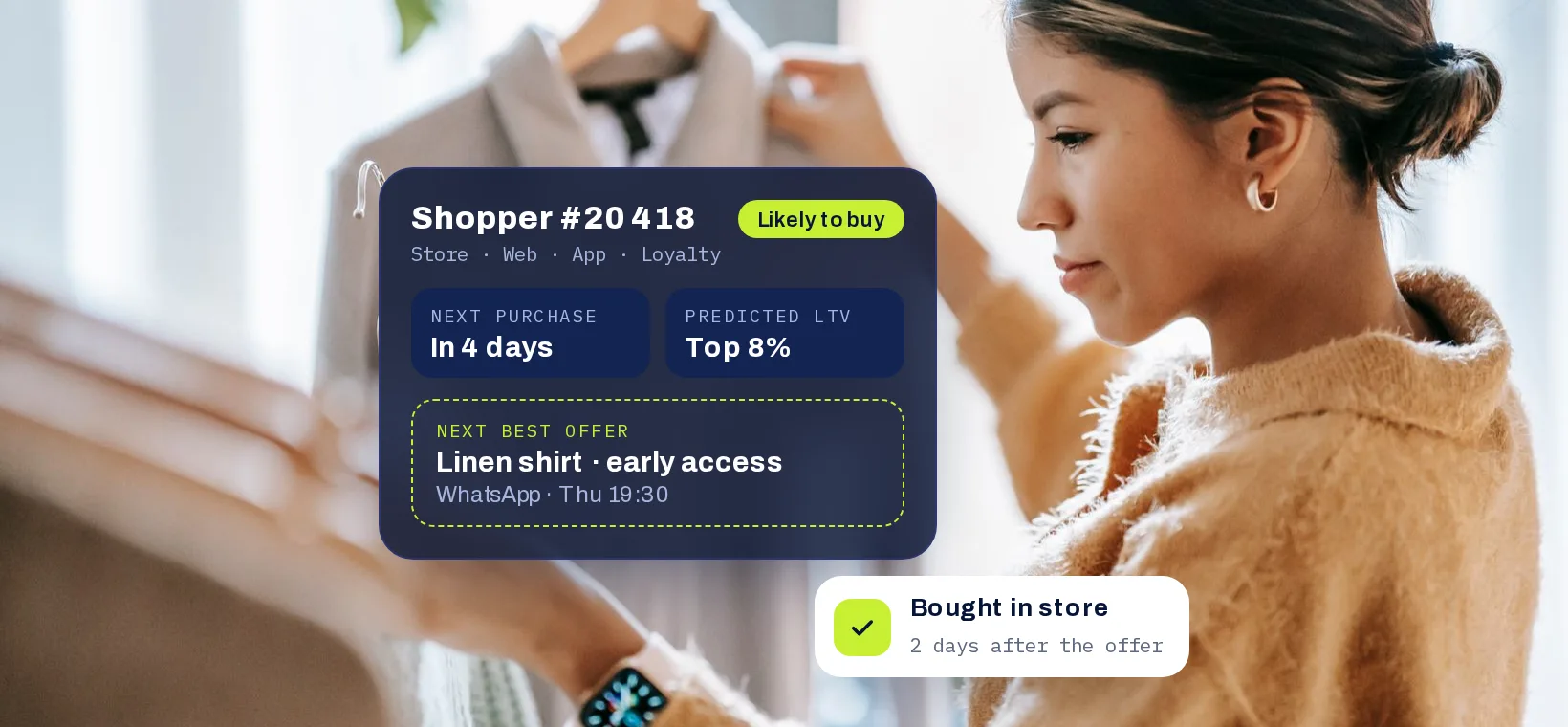
- Predictive scores (purchase probability, LTV, churn risk, Next Best Offer) belong on every shopper profile.
- Offers must respect stock and margin, or personalization costs trust and profit.
- Prove ROI with control groups. B2Metric customers see +45% customer lifetime value and +75% engagement.
- A composable CDP goes live on top of your current stack in an 8-week pilot, well before peak season.
Why most retail CDPs stop halfway
The same shopper browses on your app, compares on your website, buys in store and calls your contact center. In most retailers that is four profiles in four systems. A traditional CDP fixes that by stitching the records together. Then it hands your team a clean list and stops.
That leaves three gaps that cost retailers revenue every day:
- Looking backward. Segments are built on last month's behavior, so offers reach shoppers after the moment has passed.
- Blind to stock and margin. Recommendations push sold-out sizes or low-margin items, which hurts trust and profit at the same time.
- Stuck waiting for people. Every new segment, journey or report needs an analyst or an engineer, so good ideas sit in the backlog.
B2Metric was built to close all three: it predicts what each shopper will do next, checks what you can actually sell, and acts on it without waiting for a ticket.
How a predictive CDP works
B2Metric is an Agentic Growth Platform with a Predictive CDP at its core. Every shopper moves through the same four-step loop, and AI agents keep it running around the clock.
UnifySignalOne · Data Platform
Store POS, website, app, loyalty, call center and service data land in one real-time profile. Server-side collection means ad blockers and cookie limits leave no gaps.
PredictAutoML
Every shopper is scored for purchase probability, lifetime value, churn risk and Next Best Offer. Scores refresh as behavior changes.
Decide and actAI Decisioning Studio · Flowly
The right offer for each person, filtered by stock and margin, delivered on WhatsApp, SMS, email, push, in-app, on site or through the store team.
MeasureSignalOne
Revenue is attributed to each journey against a control group, and the results feed the next prediction.
“Which gamers looked at laptops three times this month and didn't buy?” With Asky, your team asks in plain language and gets the segment, not a ticket number.
Core capabilities a retail CDP must have
Everything a retail CDP needs, plus the part most of them skip: prediction and automated action.
| Capability | What it means for a retailer |
|---|---|
| Online-to-store identity resolution | The shopper who browses in the app and buys in store is one person. Loyalty ID, phone, email and device are matched, with a probabilistic fallback. |
| Real-time profiles | Profiles update in seconds, not overnight batches, so a cart left at 9:00 can be recovered at 10:00. |
| Predictive scores on every profile | Purchase probability, LTV, churn risk and Next Best Offer, ready to use in any segment or journey. |
| Stock- and margin-aware decisions | Offers skip sold-out sizes and protect margin. Discounts go to shoppers who need one to convert. |
| Omnichannel orchestration | WhatsApp, SMS, email, push, in-app, on-site and store associates in one journey builder, with frequency caps. |
| Paid media activation | Predictive audiences and lookalikes flow to Meta and Google; recent buyers are suppressed from ads for what they just bought. |
| Natural-language analytics | Marketers build segments and reports by asking questions, without SQL. |
| Incremental measurement | Every journey runs against a control group, so you report added revenue, not revenue that would have happened anyway. |
| Composable architecture | Runs on top of your existing ERP, POS, e-commerce platform and data warehouse. Cloud or on-premise. |
High-impact retail CDP use cases
Ten plays retailers launch first, ranked by revenue impact. Each one goes live with your current channels and is measured against a control group from day one.
| # | Use case | Trigger | What happens | Powered by |
|---|---|---|---|---|
| 01 | Stock-aware cart recovery | Cart left without checkout | Reminders at 1h, 24h and 3 days, only for items in stock, with click-and-collect when faster | SignalOne, Flowly |
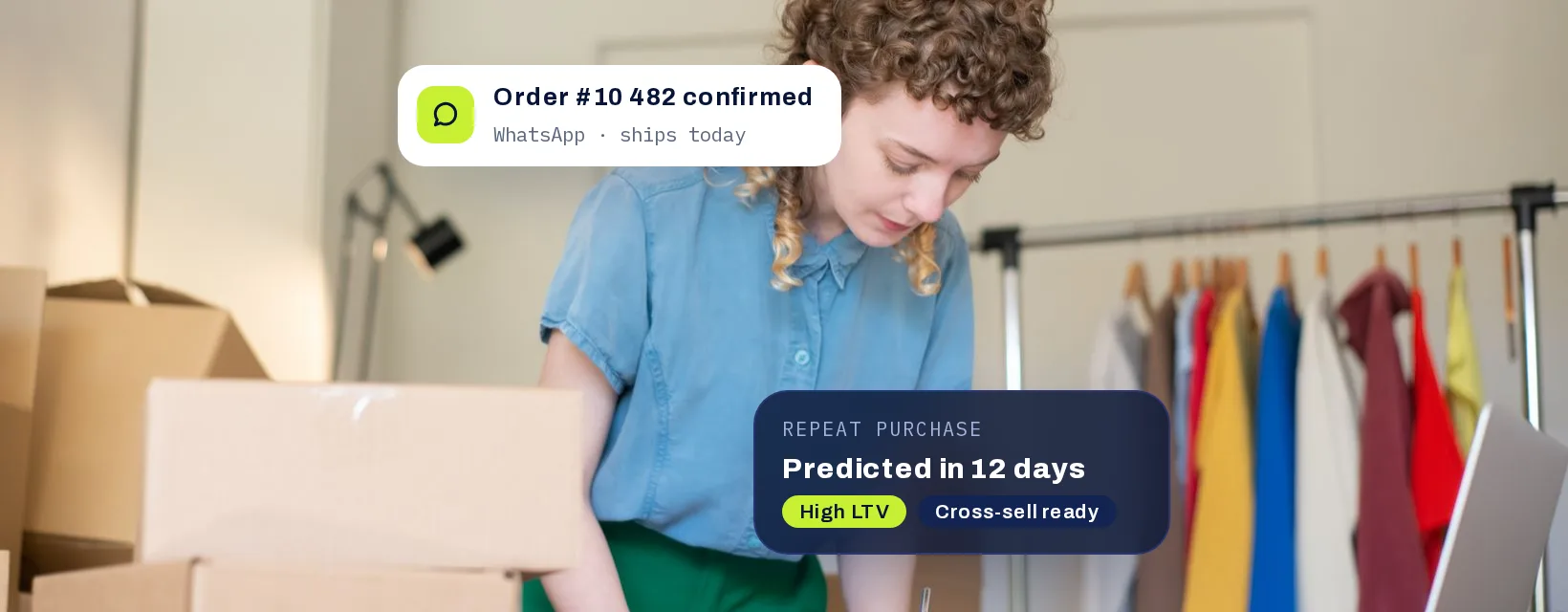
| 02 | Cross-sell after purchase | Phone, laptop, TV or apparel bought in any channel | Matching accessories, care products or extended warranty within 1 to 7 days | AutoML (NBO), Flowly |
| 03 | Decision support for comparers | 2+ products compared | Side-by-side summary with reviews, delivery date and payment options | SignalOne, AI Decisioning Studio |
| 04 | Price-drop and back-in-stock alerts | A viewed or saved item changes | Instant WhatsApp, push or email | SignalOne, Flowly |
| 05 | On-site personalization | Known segment visits | Banners, recommendations and offer order change per shopper | AI Decisioning Studio |
| 06 | First order to second | New first-time buyer | 30-day welcome journey ending in a predicted second-purchase offer | Flowly, AutoML |
| 07 | Churn prevention | Purchase gap breaks the shopper’s own pattern | Personal win-back offer, plus a call center task for high-LTV customers | ChurnShield, Flowly |
| 08 | Online research, in-store purchase | Shopper browses online and is near a store | Store invite, and the associate sees what they were looking at | SignalOne, Data Platform |
| 09 | Smarter campaign discounts | Seasonal sales and Black Friday | Discounts go to shoppers who need one; likely buyers get early access instead | AI Decisioning Studio |
| 10 | Replacement cycle | Product reaches its typical replacement age | New-model offer or trade-in campaign at launch | AutoML |
Results retailers can expect
+45%
Customer lifetime value
Predictive LTV scoring and Next Best Offer turn one-time buyers into repeat customers.
+75%
Engagement
Personalized journeys on WhatsApp, email, push and app, sent at each shopper's most active hour.
Every result is reported as incremental lift against a control group, so the number on your dashboard is revenue you would not have made otherwise.
Traditional CDP vs B2Metric Predictive CDP
A traditional CDP tells you who your customers were. B2Metric tells you what they'll do next.
| Traditional CDP | B2Metric Predictive CDP | |
|---|---|---|
| Core output | A unified customer list | A unified profile with predictions and the next action attached |
| Segments | Built by hand on past behavior | Built on predicted behavior, or by asking a question |
| Offers | Same campaign for the whole segment | Best offer per shopper, filtered by stock and margin |
| Execution | Exported to separate tools | Run by AI agents across every channel |
| Proof of ROI | Campaign reports | Incremental lift against a control group |
| Architecture | Suite or composable: pick one | Composable, on top of your existing stack |
| Time to value | 6 to 12 month projects | First use cases live in an 8-week POC |
Live before peak season
Because B2Metric sits on top of your existing systems, a pilot starts with two use cases and goes live in eight weeks. Start in Q2 and your predictive journeys are proven and running well before the Q4 code freeze.
Frequently asked questions
What is a CDP for retail?
A retail customer data platform combines store, e-commerce, app, loyalty and service data into one profile per shopper. A predictive CDP like B2Metric also forecasts what each shopper will do next and triggers the right action automatically.
How is a predictive CDP different from a regular CDP?
A regular CDP organizes historical data and leaves targeting to your team. A predictive CDP adds machine learning scores (purchase probability, lifetime value, churn risk, Next Best Offer) to every profile and uses them to decide and act in real time.
How does B2Metric handle in-store and offline data?
POS transactions, loyalty IDs, phone numbers and call center records are matched to online behavior, so a shopper who researches online and buys in store appears as one customer.
Do we need to replace our current tools or data warehouse?
No. B2Metric is composable: it runs on top of your existing ERP, POS, e-commerce platform and warehouse, and can send audiences to the tools you already use.
Which use cases deliver the fastest return?
Most retailers start with post-purchase cross-sell and stock-aware cart recovery. Both use data you already have and show measurable lift within weeks.
How long does implementation take?
A pilot with two use cases goes live in about 8 weeks: data connection, profile and model setup, live journeys, then a lift report and a scale-up plan.
How do you prove ROI?
Every journey runs with a holdout control group. You see incremental revenue, average order value, repeat purchase rate and churn, not just opens and clicks.
Stop reporting on churn. Start predicting the next purchase.
See how B2Metric would run on your own store, web and app data. In a 30-minute demo we map your top three use cases and the lift you can expect.