
The Telecom Playbook Has Changed. Is Your CVM Strategy Keeping Up?
For two decades, the telecom growth formula was simple: add subscribers, build coverage, defend market share. Customer Value Management sat downstream of that machine. A team pulled a segment on Monday, launched a bundle offer on Wednesday, and read the response rate at month-end.
That formula has run out of road. In most markets mobile penetration is above 100%, network quality is close to parity, and price wars have taught customers that loyalty is rarely rewarded. Operators that still grow are doing it by earning more from the base they already serve: higher ARPU, lower churn, deeper product holding and better margin per interaction.
That puts CVM at the center of the P&L. The question is whether your CVM function was built for this job, or for the old one.
What is customer value management in telecom?
Customer value management is the discipline of growing the long-term value of every subscriber. It combines data, prediction and engagement to decide which customers to invest in, what to offer them, when, and through which channel, so that each relationship earns more over its lifetime than it costs to serve.
In telecom, CVM spans the full lifecycle: from the first SIM activation or broadband install, through usage, upgrades and service moments, to renewal, retention and win-back. Its core outputs are measurable: lower churn, higher ARPU, more products per customer and better lifetime value.
Why CVM matters more than ever: six shifts
Each of these would stretch a traditional CVM team on its own. Together, they break the model.
01
Growth moved from acquisition to monetization
Even high-growth markets are flattening. CareEdge expects India's wireless subscriber growth to slow to 3–4% a year, with revenue now led by ARPU from the existing base.
02
More usage no longer means more revenue
China Telecom's H1 2026 results showed ARPU falling while data traffic grew. Value has to be designed into offers and tiers.
03
Switching got cheaper
eSIM, digital sub-brands and simple porting cut the friction of leaving to minutes, long before a monthly churn model flags the risk.
04
The channel became a conversation
Customers resolve, buy and upgrade in the app or on WhatsApp. Every interaction is a service moment and a sales moment, in real time.
05
AI moved from predicting to acting
The 2026 shift is from propensity scores and passive chatbots to goal-driven agents that decide and take the action themselves.
06
Consent and data residency are non-negotiable
GDPR, KVKK and Saudi PDPL mean every model and message must respect consent and where data lives. Black-box exports are now a compliance risk.
The three stages of telecom CVM
CVM is not only retention. It runs across the whole lifecycle, and each stage has its own goal, signals and plays.
- Onboard
- Activate
- Engage
- Grow
- Retain
- Win back
Stage 1
Acquire
Attract and activate customers who are likely to be valuable, not just numerous.
- Lookalike targeting from your best customers
- First-30-day onboarding journeys
- Early-life churn detection
Stage 2
Grow
Increase lifetime value with offers that evolve with each customer's needs.
- Next best offer for data, roaming and devices
- Prepaid-to-postpaid migration
- Convergence: mobile + home + digital services
Stage 3
Retain
Protect value by spotting risk early and responding with the right action at the right cost.
- Predictive churn scoring per customer
- Service-recovery journeys after network issues
- Value-based retention offers, not blanket discounts
Why traditional CVM is falling behind
Most telecom CVM stacks were built around a planning cycle: plan, design, execute, measure, repeat. That made sense when campaigns were monthly and channels were few. Today it creates five recurring problems.
- Segments are too coarse. "High-value prepaid, 25–34, urban" hides dozens of different customers, so discount budget goes to people who would have stayed anyway.
- Decisions are rule-based and slow. Hand-written rules pile up, conflict with each other and cannot react to a customer's situation in the moment.
- Models predict but do not act. Turning a churn score into a message often takes days and three teams.
- Channels and teams work in silos. The same customer can get an upsell push an hour after a complaint call.
- Success is measured by the wrong metric. Response rates reward activity. They rarely prove incremental revenue, so CVM struggles to defend its budget.
What modern CVM looks like: from campaigns to decisions
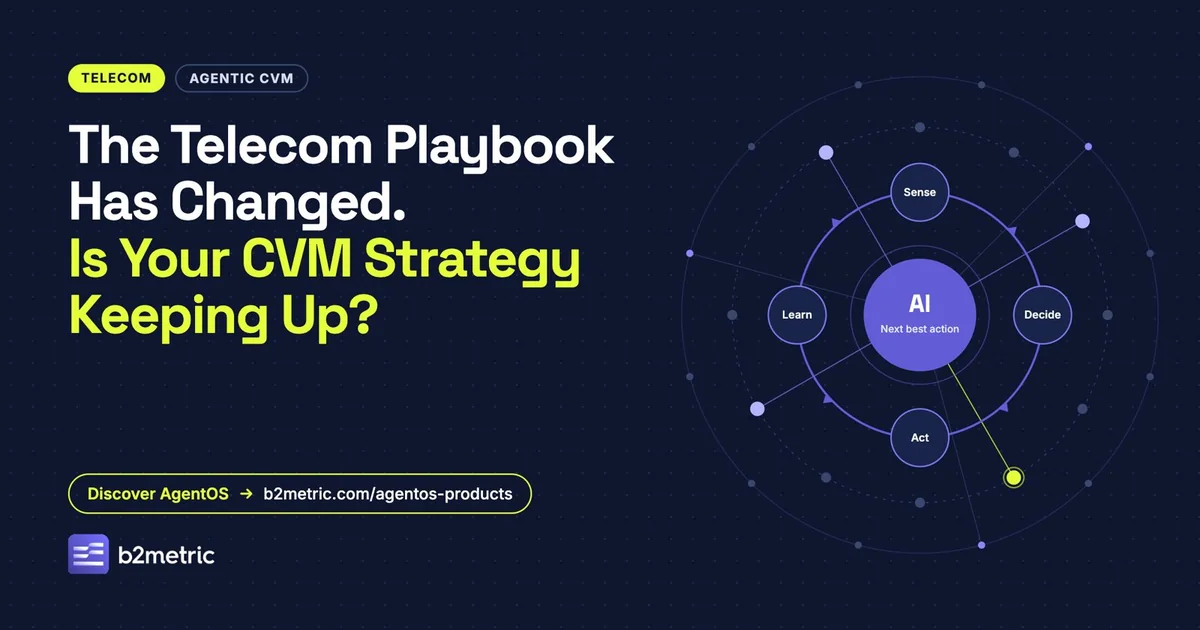
The new model runs an always-on loop for every individual customer. Instead of asking "which campaign should we run this month?", it asks "what is the next best action for this customer, right now, and what margin will it create?"
The agentic CVM loop
1 · Sense
Usage, billing, network, app and care events in one live profile
2 · Decide
AI weighs every eligible action against goals, budget and margin
3 · Act
Agents deliver it on the right channel and adapt the next step
4 · Learn
Control groups measure true uplift and retrain the models
The loop repeats for every customer, continuously, not once a month.
| Dimension | Traditional CVM | Agentic CVM |
|---|---|---|
| Unit of work | Campaign | Individual decision |
| Targeting | Static segments | Per-customer scores, refreshed continuously |
| Decision logic | Hand-written rules | AI decisioning within guardrails |
| Timing | Monthly or weekly calendar | Real time, triggered by events |
| Execution | Humans build each campaign | Agents orchestrate across channels |
| Success metric | Response rate | Incremental revenue, ARPU, churn saved |
2–5%
ARPU uplift reported for AI-driven CVM programs
30–50%
lower campaign management costs (Sofrecom industry analysis)
Building a CVM strategy for telecom, step by step
A strong CVM strategy connects data to decisions to measurable outcomes. These six steps apply whether you run a large MNO or a digital MVNO.
- Unify the customer data
Bring usage, billing, recharge, network quality, app and web behavior, care tickets and consent into one live profile per subscriber. - Segment by value and behavior, not demographics
Combine predictive scores (churn risk, lifetime value, upgrade propensity) with RFM and real-time behavior, and let segments update as customers change. - Design offers and tariffs around value
Build an offer catalog the decision engine can choose from: data packs, roaming, devices, bundles and partner services, each with clear eligibility and margin. - Map the lifecycle journeys
Define the moments that matter, from activation and first top-up to bill shock, network issues and contract end, and the journey that should run at each. - Orchestrate every channel from one place
App push, WhatsApp, SMS, email, web and the care agent's screen should follow one decision, with shared contact rules and frequency caps. - Measure incrementally and keep learning
Hold out control groups, report incremental revenue and churn saved, and feed outcomes back into the models every cycle.
What a modern CVM platform needs
Strategy only scales on the right technology. A CVM platform for telecom needs four layers working as one: a data foundation, journey orchestration, owned channels like the mobile app and WhatsApp, and AI that decides. Here is how each looks in B2Metric.
1. Journey orchestration with Flowly
Flowly is B2Metric's customer journey orchestration product. CVM teams design real-time, cross-channel journeys on one canvas, and the AI decides which branch each customer takes.
- High riskWhatsAppLoyalty bundle with bonus GB
- Low riskApp pushOne-tap 10 GB data pack
- Wait 24hIf not convertedSMS reminder + care task via API
Visual Journey Designer
Drag-and-drop canvas for multi-step journeys, with no code and no engineering ticket.
Real-Time Decision Engine
Reacts to live behavior and triggers the next action within seconds.
AI-Powered Next Best Action
Churn risk, lifetime value and behavioral signals choose the offer and message for each customer.
Omnichannel Orchestration
Email, SMS, WhatsApp, mobile push and web personalization in one flow.
Custom API Integrations
Trigger actions in your own systems: add bonus credit, issue a voucher or open a call-center task.
Dynamic Segmentation
Audiences built from real-time behavior and predictive scores that update as customers change.
Flowly sits alongside B2Metric's Campaign Management, A/B testing and experiments, and Campaign Performance Analytics, so every journey can be tested and measured.
2. Owned channels: the mobile app SDK and WhatsApp
The self-care app and WhatsApp are where telecom customers now check balances, buy packs and ask for help. They are also the cheapest, highest-intent CVM channels an operator has.
09:41
Friday, 6 November
YOURTELCOnow
You’re almost out of data
Add 10 GB for the rest of the month in one tap. Your price: 49 TL.
YOURTELCO
Roaming in Germany next week? Your pack is ready.
Hi Elif, we noticed some network drops in your area yesterday. Sorry about that. We’ve added 5 GB to your line, on us.
Want to lock in your loyalty bundle for 12 months?
See my offer
Talk to an agent
See my offer
Mobile app SDK
Turn the self-care app into a CVM engine
Native iOS and Android SDKs, plus Flutter, React Native and Web SDKs, capture in-app behavior in real time and feed it into the customer profile. The same SDK delivers app push notifications that Flowly triggers from live signals.
iOSAndroidFlutterReact NativeWeb
WhatsApp Conversational Commerce
Sell and serve in the conversation
Send personalized offers, service alerts and renewals on WhatsApp, with quick replies that let customers buy or reach an agent without leaving the chat. Every reply flows back into the profile and the next decision.
OffersService alertsRenewalsQuick replies
3. Data foundation and AI that decides
Underneath the journeys sit B2Metric's Predictive CDP, which unifies every signal into one profile with consent built in, and B2MetricAI: Customer Churn Predictor, Customer Lifetime Value, AI-Agent ChurnShield, and AI Decisioning Studio for Next Best Offer. Asky (askasky.ai) lets CVM teams ask questions of their data in plain language.
CVM in action: four telecom journeys
These are the journeys operators most often start with, because the signals already exist and the revenue line is clear.
Early-life onboarding
Signal: new line with low usage in week one.
Action: app tutorial push, then a WhatsApp check-in with a starter bonus.
Goal: activation and lower early churn.Low balance, right offer
Signal: data balance drops below a threshold.
Action: AI picks a pack size and price per customer, delivered by push or WhatsApp.
Goal: ARPU uplift without blanket discounts.Service recovery
Signal: repeated network drops or a care complaint.
Action: pause sales messages, send an apology and goodwill credit via API.
Goal: protect high-value customers at risk.Prepaid to postpaid
Signal: stable, high recharge rhythm over several months.
Action: personalized postpaid plan in the app, with care follow-up for top prospects.
Goal: higher lifetime value and stickiness.
How to measure customer value management
Good CVM measurement works on three levels: the value of the customer base, the outcomes of each activity, and what customers tell you. Incrementality ties them together.
| Level | What it answers | Key metrics |
|---|---|---|
| Customer value | Is the base worth more over time? | CLV, ARPU, products per customer, margin per subscriber |
| Activities and outcomes | Did our actions change behavior? | Incremental revenue, churn saved, offer take-up, cross-sell and upgrade rate |
| Feedback and insight | How do customers feel about it? | NPS, CSAT, complaint rate, opt-out rate |
The single most important habit: every journey runs with a control group, so you report what CVM caused, not just what happened.
CRM vs. CVM: what's the difference?
The two are often confused. CRM manages the relationship; CVM manages the value of that relationship. Operators need both, but they are not the same job.
| Aspect | CRM | CVM |
|---|---|---|
| Focus | Records and interactions | Lifetime value of each customer |
| Objective | Organize and serve the relationship | Grow revenue, reduce churn, raise margin |
| Core tools | Contact, case and sales management | CDP, predictive AI, decisioning, orchestration |
| Typical metrics | Resolution time, pipeline, contact rate | CLV, ARPU, churn saved, incremental revenue |
Is your CVM keeping up? A seven-question check
Tap each statement that is true for your operation today. Fewer than five? Your strategy is likely running behind the market.
0 / 7 in placeYour CVM is likely running behind the market.
A practical 90-day path to agentic CVM
Modernizing CVM does not require a multi-year program. The fastest operators start narrow, prove value in production and expand.
Days 1–30
Pick one use case, connect the data
Choose a problem with a clear revenue line, such as postpaid churn in a competitive region. Connect usage, billing, care and consent, and install the app SDK. Agree the control group and metric with finance.
Days 31–60
Put decisions into production
Score every customer in scope. Build the journey in Flowly and let AI pick the next best action within your offers, budget and contact rules. Launch on the app and WhatsApp.
Days 61–90
Measure, learn, scale
Read incremental results against the control group, feed outcomes back into the models, then add the next journey on the same foundation.
Why operators choose B2Metric for CVM
Telecom, both MNO and MVNO, is B2Metric's first sector. B2Metric AgentOS for CVM brings the Predictive CDP, Flowly, the mobile SDK, WhatsApp and Commercial AI Agents together in one platform, so data, decisions and channels never drift apart.
35%+
churn reduction at Türk Telekom
6+ yrs
in production at Türk Telekom
Live
stc Kuwait runs CVM on B2Metric AgentOS
ISO 27001 SOC 2
certified platform
Our Forward Deployed Engineers work alongside operator teams, so the first journey reaches production in weeks, not quarters.
Frequently asked questions
What is customer value management in telecom?
CVM is how an operator grows the long-term value of each subscriber: reducing churn, increasing ARPU and deepening product holding through the right action at the right moment.
What are the stages of CVM?
Acquire, grow and retain. Each stage has its own signals and plays, from onboarding new lines to upgrades and churn prevention.
How is CVM different from CRM?
CRM organizes customer records and interactions. CVM uses data, prediction and orchestration to grow the value of each relationship and is measured on revenue and churn outcomes.
What is agentic CVM?
Agentic CVM uses AI agents that sense customer signals, decide the next best action and execute it across channels continuously, instead of humans building monthly campaigns.
Why are the app and WhatsApp so important for CVM?
They are where customers already check balances, buy packs and ask for help. Owned channels cost less than paid ones and reach customers at the moment of intent.
How fast can an operator see results?
A focused first journey can be measured against a control group within 90 days, before scaling to others.